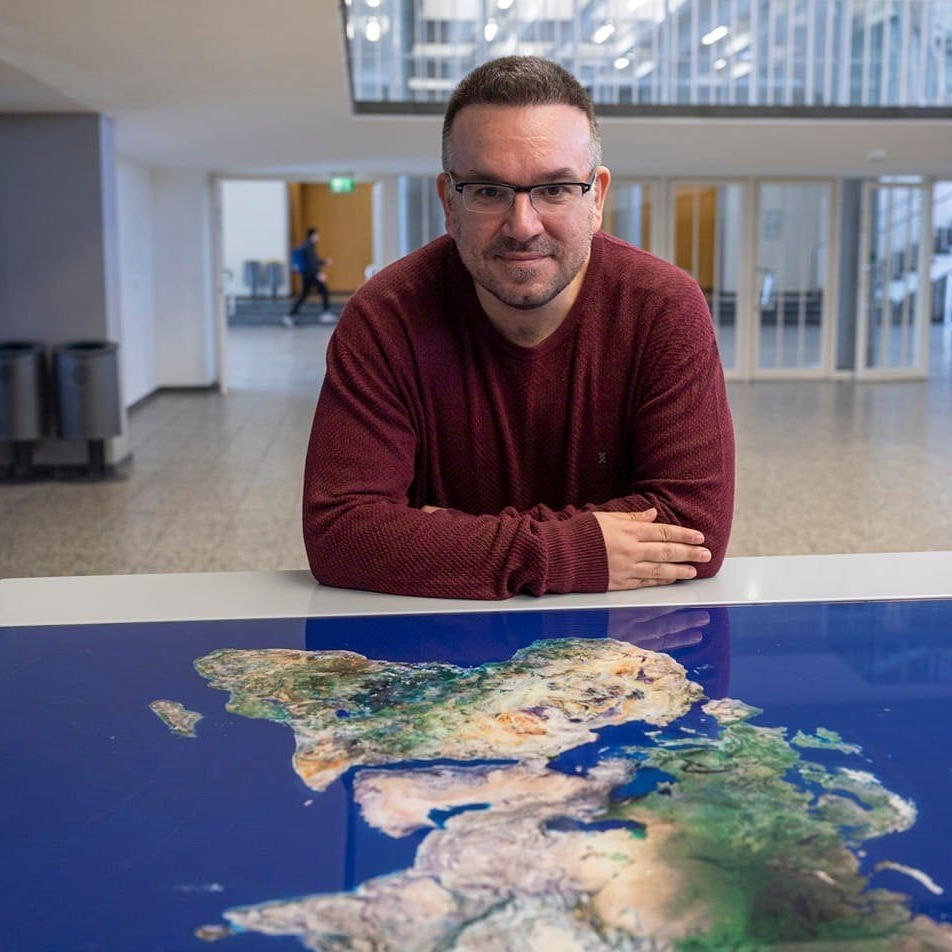
Theocharis N. Grigoriadis is Professor of Economics (W2, tenured) at the Department of Economics and the Institute for East European Studies at Freie Universität Berlin, where he also serves as Program Director of the MSc in Economic Systems (with tracks in Southeast Europe and Central Asia) and Faculty Member of the Berlin School of Economics.
His work bridges political economy, economic history, development economics, and comparative area studies, with a particular regional focus on Eastern Europe, Eurasia, and the Middle East. Trained across economics, political science, law, and Slavic studies, Grigoriadis holds a PhD in Political Science (Political Economy) from the University of California, Berkeley, a Candidate of Science in Economics (World Economy) from Saint Petersburg State University, a PhD in Slavic Literatures and Cultures (Russian) from Humboldt University of Berlin, an MA in Russian and East European Studies from Yale University, and an LLM from the University of Athens. This interdisciplinary formation informs his distinctive methodological approach, combining quantitative political economy with historical and philological analysis. His research explores the deep historical determinants of state capacity, religion, finance, and development. He is the author of Religion & Comparative Development: The Genesis of Democracy & Dictatorship (Edward Elgar, 2018) and Aid in Transition: EU Development Cooperation with Russia & Eurasia (Springer, 2016) . His current book projects include Spies & Revolutionaries: Imperial Russia’s Foreign Intelligence & the Defense of National Security and Muscovy as New Byzantium: Imperial Recoding & Orthodox Political Economy, both of which investigate the institutional and ideological foundations of imperial governance.
Grigoriadis has published extensively in leading journals across economics and political science, including the Journal of Economic History, European Economic Review, Economic History Review, Journal of International Money and Finance, European Journal of Political Economy, China Economic Review, Energy Economics, Comparative Economic Studies, and others . His empirical work spans topics such as financial development and industrialization in Imperial Russia, state capacity and fiscal federalism, religion and public goods provision, regional inequality, authoritarian institutions, monetary transmission in Eastern Europe, and the long-term economic legacies of empire. A significant component of his scholarship involves original data construction. He is the creator of the dataset “Data on Surveillance & Repression in the Russian Empire, 1886–1912,” archived at OstData (Bavarian State Library), which enables new quantitative analyses of bureaucratic incentives, repression, and national security in late imperial Russia. His broader research agenda connects historical institutional analysis with contemporary geopolitical and geoeconomic dynamics, including energy transitions, multipolarity, and conflict. He has secured substantial third-party funding as Principal Investigator from the German Research Foundation (DFG), the German Academic Exchange Service (DAAD), the European Commission (Jean Monnet Chair), the Volkswagen Foundation, and other international bodies. His grants have supported large-scale international partnerships linking Berlin with institutions in France, Turkey, Ukraine, Uzbekistan, Serbia, Georgia, Egypt, and beyond. He has also held fellowships at the Hoover Institution (Stanford), the Istanbul Policy Center (Sabancı University), and IHEAL in Paris.
At Freie Universität Berlin, Grigoriadis has served in multiple leadership roles, including Associate Director and Dean of Studies at the Institute for East European Studies and Acting Director during the 2020–21 academic year. He has taught a wide range of undergraduate and graduate courses in economic growth, development economics, comparative economic systems, energy economics, international macroeconomics, economic history, and political economy. He has supervised a large cohort of doctoral and master’s students across economics, political science, history, Iranian studies, Turkish studies, and Byzantine studies. Beyond academia, he has contributed to policy discussions on energy, development, and regional conflict through advisory work with international organizations and think tanks, including the European Commission, UN ESCWA, and various European foundations. His multilingual competence—spanning Greek, English, French, German, Russian, Ukrainian, Turkish, Arabic, Ottoman Turkish, and others—enables archival research and policy engagement across multiple regions. Professor Grigoriadis’ work is characterized by its integration of theory, history, and empirics. By combining long-run institutional analysis with modern quantitative methods, he seeks to explain how empires, religions, and political regimes shape economic development and global order.