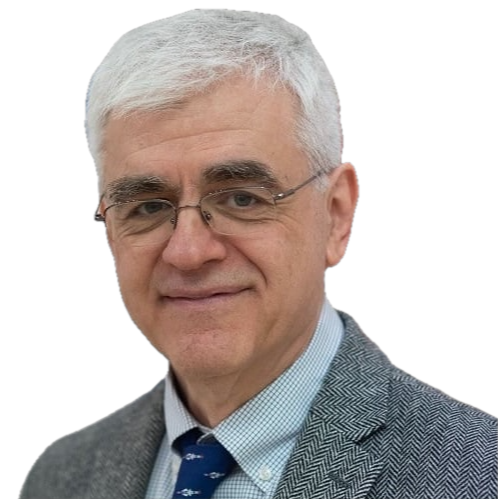
Efthimios Kaxiras started his higher education at the National Technical University of Athens (Department of Electrical Engineering), and continued at the Massachusetts Institute of Technology where he received a Bachelor of Science degree (1981) and a PhD in theoretical condensed matter physics (1987). He was a Postdoctoral Fellow at the IBM T.J. Watson Research Center (New York) and became a faculty member of Harvard University in 1991, as the Gordon McKay Professor of Applied Physics in the School of Engineering and Applied Sciences and Professor of Physics in the Department of Physics. He has also been Professor and Chair at the Department of Materials Science and Technology of the University of Ioannina (Greece), Director of the Biomedical Research Institute of the Foundation of Research and Technology – Hellas (FORTH), Visiting Professor of Computational Science at the Swiss Federal Institute of Technology (ETH) in Zurich (Switzerland), Director of Harvard’s Initiative in Innovative Computing and Associate Director of the Materials Science and Engineering Center, and Professor of Materials Science and Director of the Laboratory for Multiscale Modeling of Materials, at the Institute of Materials, Ecole Polytechnique Federale de Lausanne (Switzerland). He is the Founding Director (2010-2013) and Director (2017-2020) of the Institute for Applied Computational Science at the School of Engineering and Applied Sciences at Harvard. He has also served Area Chair of Applied Mathematics (2017-2020) and Chair of the Department of Physics (2020-2023) at Harvard. He is currently the holder of the named chair John Hasbrouck Van Vleck Professor of Pure and Applied Physics at Harvard. He is pioneer in developing new pedagogical methods in teaching undergraduate courses at Harvard, with emphasis in the use of modern computational tools, and has developed several such courses in physics, chemistry, applied mathematics and applied physics. He holds several academic distinctions such as Fellow of the American Physical Society and Chartered Physicist and Fellow of the Institute of Physics (London). In 2024 he was awarded an honorary Doctoral degree from the Physics Department of the University of Ioannina, and in 2025 he was elected Honorary Professor of the Physics Department of the University of Crete. His research field is computational materials science in a broad sense, ranging from the electronic properties of crystalline and amorphous solids and their dependence on the atomic structure, to the nature of electronic states and optical properties of biomolecules like DNA, melanin, flavonoids and organic dyes, to the microscopic origin of brittle or ductile response of solids and the effects of chemical impurities on mechanical behavior. His group has developed several original approaches for realistic simulations of solids, including inter-atomic potentials for covalent systems, real-space based methods for electronic structure calculations, and effective tight-binding Hamiltonians for the treatment of very large systems of atoms. He has been a pioneer in developing multi-scale methodologies with the aim of capturing the behavior of complex physical systems starting at a fundamental level with a first-principles quantum mechanical description and reaching to macroscopic scales. His most recent research has focused on the properties of two-dimensional, layered materials and in particular on the topic of twistronics (a term introduced by his group to describe the extraordinary behavior of these solids as a function of the relative twist angle between successive layers). He serves on the Editorial Board of several scientific journals, has published over 530 research papers in peer-reviewed scientific journals and several review articles in books. He has also authored or co-authored textbooks on Atomic and Electronic Structure of Solids (Cambridge University Press, 2003), Quantum Theory of Materials (with J.D. Joannopoulos, Cambridge University Press 2019), and on Modern Mathematical Methods for Scientists and Engineers (with A. Fokas, World Scientific Press, 2023). His scientific research has been highly cited, with a total number of citations exceeding 71,000 (Google Scholar, March 2026).
Thursday 23
16.45 - 17.30
Artificial Intelligence, Innovation, and Competitiveness in the Transatlantic Economy
Ianthi Hall | Amalia Hotel
Programming Partner: American Hellenic Chamber of Commerce